The Art of Critical Reading 4th Edition Answer Key Chapter 1


The Art of the United kingdom of great britain and northern ireland refers to all forms of visual art in or associated with the Uk since the formation of the Kingdom of Keen Great britain in 1707 and encompasses English art, Scottish art, Welsh art and Irish art, and forms part of Western fine art history. During the 18th century, Britain began to repossess the leading place England had previously played in European art during the Center Ages, being especially strong in portraiture and landscape fine art.
Increased British prosperity at the time led to a greatly increased product of both art and the decorative arts, the latter often being exported. The Romantic menstruum resulted from very various talents, including the painters William Blake, J. Yard. Due west. Turner, John Constable and Samuel Palmer. The Victorian flow saw a great multifariousness of art, and a far bigger quantity created than earlier. Much Victorian art is now out of disquisitional favour, with involvement concentrated on the Pre-Raphaelites and the innovative movements at the finish of the 18th century.
The training of artists, which had long been neglected, began to better in the 18th century through private and authorities initiatives, and greatly expanded in the 19th century. Public exhibitions and the later on opening of museums brought art to a wider public, especially in London. In the 19th century publicly displayed religious art once once more became popular after a virtual absence since the Reformation, and, as in other countries, movements such every bit the Pre-Raphaelite Brotherhood and the Glasgow School contended with established Academic fine art.
The British contribution to early Modernist fine art was relatively small, but since World War Ii British artists have made a considerable impact on Contemporary art, peculiarly with figurative work, and Britain remains a cardinal centre of an increasingly globalized fine art world.[ citation needed ]
Groundwork [edit]

The oldest surviving British art includes Stonehenge from around 2600 BC, and tin can and gold works of art produced by the Chalice people from effectually 2150 BC. The La Tène style of Celtic fine art reached the British Isles rather belatedly, no earlier than about 400 BC, and developed a particular "Insular Celtic" style seen in objects such every bit the Battersea Shield, and a number of bronze mirror-backs decorated with intricate patterns of curves, spirals and trumpet-shapes. Merely in the British Isles can Celtic decorative style exist seen to have survived throughout the Roman period, as shown in objects like the Staffordshire Moorlands Pan and the resurgence of Celtic motifs, now composite with Germanic interlace and Mediterranean elements, in Christian Insular art. This had a brief but spectacular flowering in all the countries that now grade the United Kingdom in the 7th and 8th centuries, in works such as the Book of Kells and Book of Lindisfarne. The Insular style was influential beyond Northern Europe, and particularly and then in later on Anglo-Saxon art, although this received new Continental influences.
The English contribution to Romanesque fine art and Gothic art was considerable, especially in illuminated manuscripts and monumental sculpture for churches, though the other countries were now essentially provincial, and in the 15th century United kingdom struggled to keep upwards with developments in painting on the Continent. A few examples of top-quality English painting on walls or panel from before 1500 have survived, including the Westminster Retable, The Wilton Diptych and some survivals from paintings in Westminster Abbey and the Palace of Westminster.[ane]
The Protestant Reformations of England and Scotland were especially subversive of existing religious art, and the product of new piece of work virtually ceased. The Artists of the Tudor Courtroom were more often than not imported from Europe, setting a blueprint that would continue until the 18th century. The portraiture of Elizabeth I ignored contemporary European Renaissance models to create iconic images that border on naive art. The portraitists Hans Holbein and Anthony van Dyck were the almost distinguished and influential of a large number of artists who spent extended periods in Great britain, generally eclipsing local talents similar Nicolas Hilliard, the painter of portrait miniatures, Robert Peake the elderberry, William Larkin, William Dobson, and John Michael Wright, a Scot who mostly worked in London.[2]
Landscape painting was as yet little developed in Britain at the time of the Union, merely a tradition of marine art had been established by the begetter and son both called Willem van de Velde, who had been the leading Dutch maritime painters until they moved to London in 1673, in the middle of the Third Anglo-Dutch War.[3]
Early 18th century [edit]

The and so-called Acts of Union 1707 came in the heart of the long menstruation of domination in London of Sir Godfrey Kneller, a German language portraitist who had eventually succeeded every bit principal court painter the Dutch Sir Peter Lely, whose fashion he had adopted for his enormous and formulaic output, of greatly varying quality, which was itself repeated by an regular army of lesser painters. His counterpart in Edinburgh, Sir John Baptist Medina, born in Brussels to Spanish parents, had died just before the Marriage took place, and was 1 of the last batch of Scottish knights to exist created. Medina had start worked in London, merely in mid-career moved to the less competitive environment of Edinburgh, where he dominated portraiture of the Scottish elite. Yet, afterwards the Union the movement was to exist all in the other direction, and Scottish aristocrats resigned themselves to paying more to have their portraits painted in London, even if past Scottish painters such equally Medina's educatee William Aikman, who moved down in 1723, or Allan Ramsay.[four]
There was an alternative, more direct, tradition in British portraiture to that of Lely and Kneller, tracing back to William Dobson and the German or Dutch Gerard Soest, who trained John Riley, to whom only a few works are firmly attributed and who in plough trained Jonathan Richardson, a fine artist who trained Thomas Hudson who trained Joshua Reynolds and Joseph Wright of Derby. Richardson also trained the most notable Irish portraitist of the period, Charles Jervas who enjoyed social and financial success in London despite his articulate limitations every bit an artist.[5]
An exception to the dominance of the "lower genres" of painting was Sir James Thornhill (1675/76–1734) who was the starting time and last significant English painter of huge Baroque allegorical decorative schemes, and the starting time native painter to be knighted. His best-known piece of work is at Greenwich Infirmary, Blenheim Palace and the cupola of Saint Paul's Cathedral, London. His drawings show a taste for strongly drawn realism in the management his son-in-law William Hogarth was to pursue, but this is largely overridden in the finished works, and for Greenwich he took to center his careful list of "Objections that will arise from the evidently representation of the Male monarch's landing as it was in fact and in the modern way and apparel" and painted a conventional Baroque glorification.[6] Like Hogarth, he played the nationalist carte du jour in promoting himself, and eventually beat Sebastiano Ricci to enough commissions that in 1716 he and his team retreated to France, Giovanni Antonio Pellegrini having already left in 1713. Once the other leading foreign painters of allegoric schemes, Antonio Verrio and Louis Laguerre, had died in 1707 and 1721 respectively, Thornhill had the field to himself, although past the end of his life commissions for one thousand schemes had stale up from changes in gustatory modality.[7]
From 1714 the new Hanoverian dynasty conducted a far less ostentatious court, and largely withdrew from patronage of the arts, other than the necessary portraits. Fortunately, the booming British economy was able to supply aristocratic and mercantile wealth to replace the court, above all in London.[8]
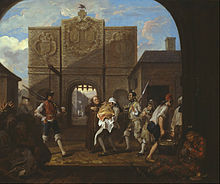
William Hogarth was a not bad presence in the 2nd quarter of the century, whose art was successful in achieving a detail English grapheme, with vividly moralistic scenes of contemporary life, total of both satire and pathos, attuned to the tastes and prejudices of the Protestant centre-class, who bought the engraved versions of his paintings in huge numbers. Other subjects were simply issued as prints, and Hogarth was both the first significant British printmaker, and however the best known. Many works were series of 4 or more scenes, of which the best known are: A Harlot's Progress and A Rake's Progress from the 1730s and Spousal relationship à-la-mode from the mid-1740s. In fact, although he simply once briefly left England and his own propaganda asserted his Englishness and frequently attacked the Old Masters, his background in printmaking, more closely aware of Continental fine art than most British painting, and apparently his ability to quickly absorb lessons from other painters, meant that he was more aware of, and fabricated more use of, Continental art than about of his contemporaries.
Like many later painters Hogarth wanted above all to achieve success at history painting in the Grand Manner, but his few attempts were not successful and are now petty regarded. His portraits were mostly of middle-class sitters shown with an credible realism that reflected both sympathy and flattery, and included some in the stylish form of the conversation piece, recently introduced from France by Philippe Mercier, which was to remain a favourite in Britain, taken up by artists such as Francis Hayman, though ordinarily abandoned one time an artist could get good single figure commissions.[9]

Silver teapot by Samuel Courtauld, London, 1748–49
There was a recognition that, even more than than the rest of Europe given the lack of British artists, the training of artists needed to be extended beyond the workshop of established masters, and various attempts were made to set up academies, starting with Kneller in 1711, with the help of Pellegrini, in Great Queen Street. The academy was taken over by Thornhill in 1716, merely seems to have become inactive by the time John Vanderbank and Louis Chéron set their own academy in 1720. This did not last long, and in 1724/v Thornhill tried over again in his ain house, with footling success. Hogarth inherited the equipment for this, and used information technology to start the St. Martin's Lane Academy in 1735, which was the well-nigh enduring, somewhen beingness absorbed by the Royal Academy in 1768. Hogarth also helped solve the trouble of a lack of exhibition venues in London, arranging for shows at the Foundling Hospital from 1746.[10]
The Scottish portraitist Allan Ramsay worked in Edinburgh before moving to London by 1739. He made visits of three years to Italy at the beginning and cease of his career, and anticipated Joshua Reynolds in bringing a more relaxed version of "Grand Manner" to British portraiture, combined with very sensitive handling in his best work, which is by and large agreed to take been of female sitters. His main London rival in the mid-century, until Reynolds fabricated his reputation, was Reynold's master, the stodgy Thomas Hudson.[xi]
John Wootton, active from about 1714 to his death in 1765, was the leading sporting painter of his day, based in the capital of English language horse racing at Newmarket, and producing large numbers of portraits of horses and also boxing scenes and conversation pieces with a hunting or riding setting. He had begun life every bit a page to the family of the Dukes of Beaufort, who in the 1720s sent him to Rome, where he acquired a classicising landscape style based on that of Gaspard Dughet and Claude, which he used in some pure landscape paintings, also equally views of country houses and equine subjects. This introduced an alternative to the various Dutch and Flemish artists who had previously set the prevailing landscape style in United kingdom of great britain and northern ireland, and through intermediary artists such as George Lambert, the first British painter to base a career on landscape subjects, was to profoundly influence other British artists such as Gainsborough.[12] Samuel Scott was the best of the native marine and townscape artists, though in the latter specialization he could not match the visiting Canaletto, who was in England from nine years from 1746, and whose Venetian views were a favourite souvenir of the One thousand Tour.[13]


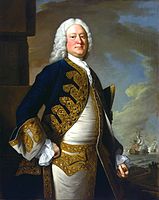

The antiquary and engraver George Vertue was a figure in the London fine art scene for most of the period, and his copious notebooks were adapted and published in the 1760s past Horace Walpole as Some Anecdotes of Painting in England, which remains a master source for the period.[14]
From his inflow in London in 1720, the Flemish sculptor John Michael Rysbrack was the leader in his field until the inflow in 1730 of Louis-François Roubiliac who had a Rococo style which was highly effective in busts and small figures, though past the following decade he was also commissioned for larger works. He too produced models for the Chelsea porcelain factory founded in 1743, a individual enterprise which sought to compete with Continental factories mostly established past rulers. Roubiliac's fashion formed that of the leading native sculptor Sir Henry Cheere, and his brother John who specialized in statues for gardens.[15]
The strong London silversmithing trade was dominated by the descendants of Huguenot refugees like Paul de Lamerie, Paul Crespin, Nicholas Sprimont, and the Courtauld family unit, as well as Georges Wickes. Orders were received from as far away as the courts of Russia and Portugal, though English styles were still led by Paris.[16] The industry of silk at Spitalfields in London was also a traditional Huguenot business organisation, but from the late 1720s silk design was dominated by the surprising effigy of Anna Maria Garthwaite, a parson'south daughter from Lincolnshire who emerged at the historic period of twoscore as a designer of largely floral patterns in Rococo styles.[17]
Unlike in France and Frg, the English adoption of the Rococo fashion was patchy rather than whole-hearted, and in that location was resistance to it on nationalist grounds, led by Richard Boyle, 3rd Earl of Burlington and William Kent, who promoted styles in interior pattern and furniture to match the Palladianism of the compages they produced together, also beginning the influential British tradition of the mural garden,[18] co-ordinate to Nikolaus Pevsner "the most influential of all English innovations in fine art".[19] The French-built-in engraver Hubert-François Gravelot, in London from 1732 to 1745, was a key effigy in importing Rococo taste in book illustrations and ornament prints for craftsmen to follow.[20]
Late 18th century [edit]


In the modern popular mind, English art from about 1750–1790 — today referred to equally the "classical age" of English painting — was dominated by Sir Joshua Reynolds (1723–1792), George Stubbs (1724–1806), Thomas Gainsborough (1727–1788) and Joseph Wright of Derby (1734–1797). At the time Reynolds was considered the dominant figure, Gainsborough was very highly reputed, simply Stubbs was seen every bit a mere painter of animals and viewed every bit far a less pregnant figure than many other painters that are today little-known or forgotten. The flow saw continued rising prosperity for United kingdom of great britain and northern ireland and British artists: "By the 1780s English painters were among the wealthiest men in the land, their names familiar to newspaper readers, their quarrels and cabals the talk of the town, their subjects known to everyone from the displays in the print-store windows", according to Gerald Reitlinger.[21]
Reynolds returned from a long visit to Italy in 1753, and very chop-chop established a reputation as the most fashionable London portraitist, and before long as a formidable figure in society;, the public leader of the arts in Britain. He had studied both classical and modern Italian art, and his compositions discreetly re-utilize models seen on his travels. He could convey a wide range of moods and emotions, whether heroic war machine men or very immature women, and often to unite background and effigy in a dramatic mode.[22]
The Social club for the encouragement of Arts, Articles & Commerce had been founded in 1754, principally to provide a location for exhibitions. In 1761 Reynolds was a leader in founding the rival Society of Artists of Great Britain, where the artists had more control. This continued until 1791, despite the founding of the Royal Academy of Arts in 1768, which immediately became both the nearly important exhibiting organization and the about important school in London. Reynolds was its showtime President, property the function until his death in 1792. His published Discourses, offset delivered to the students, were regarded as the first major writing on art in English, and ready out the aspiration for a style to match the classical grandeur of classical sculpture and High Renaissance painting.[23]
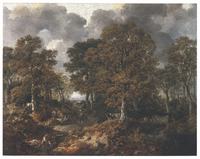
After the Academy was established, Reynolds' portraits became more overly classicizing, and often more distant, until in the late 1770s he returned to a more intimate style, perhaps influenced by the success of Thomas Gainsborough,[24] who only settled in London in 1773, after working in Ipswich and and so Bath. While Reynolds' practice of aristocratic portraits seem exactly matched to his talents, Gainsborough, if not forced to follow the marketplace for his work, might well take developed every bit a pure landscape painter, or a portraitist in the informal style of many of his portraits of his family unit. He continued to paint pure landscapes, largely for pleasure until his later on years; total recognition of his landscapes came only in the 20th century. His principal influences were French in his portraits and Dutch in his landscapes, rather than Italian, and he is famous for the bright lite touch of his brushwork.[25] George Romney also became prominent in most 1770 and was active until 1799, though with a falling-off in his last years. His portraits are mostly characterful only flattering images of dignified guild figures, but he developed an obsession with the flighty young Emma Hamilton from 1781, painting her about sixty times in more than extravagant poses.[26] His work was peculiarly sought-after by American collectors in the early on 20th century and many are now in American museums.[27] By the end of the period this generation had been succeeded by younger portraitists including John Hoppner, Sir William Beechey and the young Gilbert Stuart, who just realized his mature way after he returned to America.[28]
The Welsh painter Richard Wilson returned to London from 7 years in Italy in 1757, and over the next two decades adult a "sublime" mural manner adapting the Franco-Italian tradition of Claude and Gaspard Dughet to British subjects. Though much admired, like those of Gainsborough his landscapes were hard to sell, and he sometimes resorted, as Reynolds complained, to the common strategem of turning them into history paintings by adding a few pocket-sized figures, which doubled their price to virtually £80.[29] He continued to pigment scenes set in Italia, as well as England and Wales, and his death in 1782 came simply every bit large numbers of artists began to travel to Wales, and afterwards the Lake District and Scotland in search of mountainous views, both for oil paintings and watercolours which were now starting their long period of popularity in Britain, both with professionals and amateurs. Paul Sandby, Francis Towne, John Warwick Smith, and John Robert Cozens were among the leading specialist painters and the clergyman and amateur artist William Gilpin was an important writer who stimulated the popularity of amateur painting of the picturesque, while the works of Alexander Cozens recommended forming random ink blots into landscape compositions—even Constable tried this technique.[30]
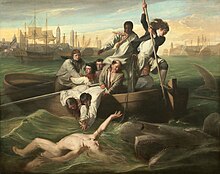
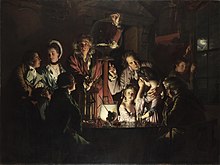
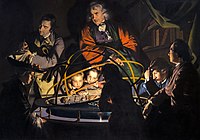
History painting in the yard fashion continued to be the most prestigious grade of art, though not the easiest to sell, and Reynolds made several attempts at information technology, every bit unsuccessful as Hogarth'south. The unheroic nature of modern dress was seen as a major obstacle in the depiction of gimmicky scenes, and the Scottish gentleman-artist and fine art dealer Gavin Hamilton preferred classical scenes besides as painting some based on his Eastern travels, where his European figures by-passed the problem by wearing Arab dress. He spent virtually of his adult life based in Rome and had at least as much influence on Neo-Classicism in Europe as in United kingdom of great britain and northern ireland. The Irishman James Barry was an influence on Blake but had a hard career, and spent years on his bicycle The Progress of Homo Civilisation in the Great Room of the Purple Society of Arts. The almost successful history painters, who were non afraid of buttons and wigs, were both Americans settled in London: Benjamin W and John Singleton Copley, though one of his most successful works Watson and the Shark (1778) was able to more often than not avoid them, showing a rescue from drowning. Smaller calibration subjects from literature were also popular, pioneered by Francis Hayman, i of the get-go to pigment scenes from Shakespeare, and Joseph Highmore, with a serial illustrating the novel Pamela. At the end of the catamenia the Boydell Shakespeare Gallery was an aggressive project for paintings, and prints after them, illustrating "the Bard", as he had now become, while exposing the limitations of contemporary English history painting.[31] Joseph Wright of Derby was mainly a portrait painter who also was i of the get-go artists to depict the Industrial Revolution, every bit well as developing a cross between the conversation piece and history painting in works similar An Experiment on a Bird in the Air Pump (1768) and A Philosopher Lecturing on the Orrery (c. 1766), which like many of his works are lit just by candlelight, giving a strong chiaroscuro outcome.[32]
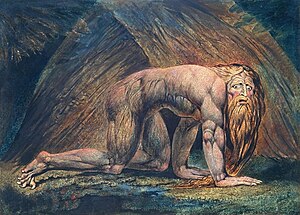
Paintings recording scenes from the theatre were some other subgenre, painted by the German Johann Zoffany among others. Zoffany painted portraits and conversation pieces, who also spent over ii years in Bharat, painting the English nabobs and local scenes, and the expanding British Empire played an increasing part in British art.[33] Training in art was considered a useful skill in the armed services for sketch maps and plans, and many British officers fabricated the first Western images, often in watercolour, of scenes and places around the globe. In Republic of india, the Company fashion developed as a hybrid form between Western and Indian art, produced by Indians for a British market place.
Thomas Rowlandson produced watercolours and prints satirizing British life, but mostly avoided politics. The primary of the political caricature, sold individually by print shops (often acting equally publishers likewise), either hand-coloured or plain, was James Gillray.[34] The emphasis on portrait-painting in British fine art was not entirely due to the vanity of the sitters. There was a large collector's market for portrait prints, mostly reproductions of paintings, which were oft mounted in albums. From the mid-century at that place was a cracking growth in the expensive merely more effective reproductions in mezzotint, of portraits and other paintings, with special need from collectors for early on proof states "before letter of the alphabet" (that is, earlier the inscriptions were added), which the printmakers obligingly printed off in growing numbers.[35]
This period marked one of the high points in British decorative arts. Around the mid-century many porcelain factories opened, including Bow in London, and in the provinces Lowestoft, Worcester, Royal Crown Derby, Liverpool, and Wedgwood, with Spode post-obit in 1767. Nearly were started equally small concerns, with some lasting only a few decades while others still survive today. Past the stop of the period British porcelain services were being commissioned past foreign royalty and the British manufacturers were especially expert at pursuing the rapidly expanding international centre-class market, developing os china and transfer-printed wares as well as hand-painted true porcelain.[36]
The three leading article of furniture makers, Thomas Chippendale (1718–1779), Thomas Sheraton (1751–1806) and George Hepplewhite (1727?–1786) had varied styles and take accomplished the lasting fame they have mainly as the authors of blueprint books used by other makers in Britain and abroad. In fact it is far from articulate if the last 2 named always ran actual workshops, though Chippendale certainly was successful in this and in what we now call interior pattern; unlike French republic Britain had abandoned its guild organization, and Chippendale was able to apply specialists in all the crafts needed to complete a redecoration.[37] During the catamenia Rococo and Chinoiserie gave style to Neo-Classicism, with the Scottish architect and interior designer Robert Adam (1728–1792) leading the new fashion.



19th century and the Romantics [edit]
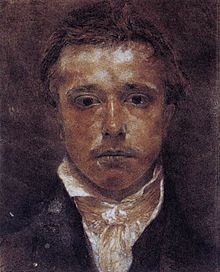
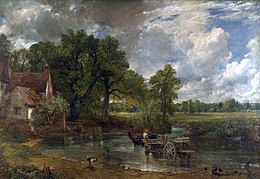
The tardily 18th century and the early 19th century characterized past the Romantic movement in British art includes Joseph Wright of Derby, James Ward, Samuel Palmer, Richard Parkes Bonington, John Martin and was perhaps the most radical flow in British art, also producing William Blake (1757–1827), John Constable (1776–1837) and J.M.Due west. Turner (1775–1851), the later on two being arguably the virtually internationally influential of all British artists.[38] [39] Turner'south mode, based on the Italianate tradition although he never saw Italy until in his forties, passed through considerable changes earlier his concluding wild, almost abstract, landscapes that explored the effects of low-cal, and were a profound influence on the Impressionists and other later movements.[40] Constable usually painted pure landscapes with at most a few genre figures, in a fashion based on Northern European traditions, but, similar Turner, his "six-footers" were intended to make every bit striking an impact as any history painting.[41] They were carefully prepared using studies and full-size oil sketches,[42] whereas Turner was notorious for finishing his exhibition pieces when they were already hanging for show, freely adjusting them to boss the surrounding works in the tightly-packed hangs of the day.[43]

Blake's visionary style was a minority taste in his lifetime, but influenced the younger grouping of "Ancients" of Samuel Palmer, John Linnell, Edward Calvert and George Richmond, who gathered in the country at Shoreham, Kent in the 1820s, producing intense and lyrical pastoral idylls in conditions of some poverty. They went on to more than conventional creative careers and Palmer's early work was entirely forgotten until the early on 20th century.[44] Blake and Palmer became a pregnant influence on modernist artists of the 20th century seen (among others) in the painting of British artists such as Dora Carrington,[45] Paul Nash and Graham Sutherland.[46] Blake also had an enormous influence on the trounce poets of the 1950s and the counterculture of the 1960s.[47]
Thomas Lawrence was already a leading portraitist past the start of the 20th century, and able to give a Romantic dash to his portraits of high club, and the leaders of Europe gathered at the Congress of Vienna afterwards the Napoleonic Wars. Henry Raeburn was the most meaning portraitist since the Union to remain based in Edinburgh throughout his career, an indication of increasing Scottish prosperity.[48] Merely David Wilkie took the traditional road south, achieving neat success with subjects of country life and hybrid genre and history scenes such as The Chelsea Pensioners reading the Waterloo Dispatch (1822).[49]
John Flaxman was the most thorough-going neo-classical English artist. Outset as a sculptor, he became best known for his many spare "outline drawings" of classical scenes, oftentimes illustrating literature, which were reproduced equally prints. These imitated the effects of the classical-style reliefs he also produced. The German-Swiss Henry Fuseli also produced work in a linear graphic style, merely his narrative scenes, oftentimes from English language literature, were intensely Romantic and highly dramatic.[l]


Victorian art [edit]
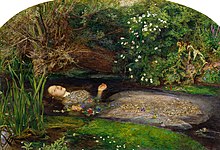
The Pre-Raphaelite Brotherhood (PRB) achieved considerable influence after its foundation in 1848 with paintings that full-bodied on religious, literary, and genre subjects executed in a colourful and minutely detailed style, rejecting the loose painterly brushwork of the tradition represented by "Sir Sloshua" Reynolds. PRB artists included John Everett Millais, William Holman Hunt, Dante Gabriel Rossetti, and Ford Madox Dark-brown (never officially a member), and figures such as Edward Burne-Jones and John William Waterhouse were later much influenced past aspects of their ideas, as was the designer William Morris. Morris advocated a render to hand-craftsmanship in the decorative arts over the industrial manufacture that was apace being practical to all crafts. His efforts to make beautiful objects affordable (or even free) for everyone led to his wallpaper and tile designs defining the Victorian aesthetic and instigating the Craft motion.
The Pre-Raphaelites, like Turner, were supported past the authoritative fine art critic John Ruskin, himself a fine apprentice creative person. For all their technical innovation, they were both traditional and Victorian in their adherence to the history painting as the highest course of art, and their subject matter was thoroughly in tune with Victorian taste, and indeed "everything that the publishers of steel engravings welcomed",[51] enabling them to merge easily into the mainstream in their later careers.[52]

While the Pre-Raphaelites had a turbulent and divided reception, the most popular and expensive painters of the period included Edwin Landseer, who specialized in sentimental brute subjects, which were favourites of Queen Victoria and Prince Albert. In the later part of the century artists could earn large sums from selling the reproduction rights of their paintings to impress publishers, and works of Landseer, especially his Monarch of the Glen (1851), a portrait of a Highland stag, were amongst the most pop. Like Millais' Bubbles (1886) it was used on packaging and advertisements for decades, for brands of whisky and soap respectively.[53]
During the late Victorian era in United kingdom the academic paintings, some enormously large, of Lord Leighton and the Dutch-born Lawrence Alma-Tadema were enormously popular, both often featuring lightly clad beauties in exotic or classical settings, while the allegorical works of G. F. Watts matched the Victorian sense of high purpose. The classical ladies of Edward Poynter and Albert Moore wore more dress and met with rather less success. William Powell Frith painted highly detailed scenes of social life, typically including all classes of social club, that include comic and moral elements and have an acknowledged debt to Hogarth, though tellingly different from his work.[54]
For all such artists the Majestic University Summer Exhibition was an essential platform, reviewed at huge length in the printing, which oftentimes alternated ridicule and extravagant praise in discussing works. The ultimate, and very rare, award was when a rail had to be put in front end of a painting to protect it from the eager crowd; up to 1874 this had only happened to Wilkie'due south Chelsea Pensioners, Frith's The Derby Twenty-four hour period and Salon d'Or, Homburg and Luke Filde'southward The Casual Ward (encounter below).[55] A great number of artists laboured year after year in the promise of a hit there, often working in manners to which their talent was not really suited, a trope exemplified past the suicide in 1846 of Benjamin Haydon, a friend of Keats and Dickens and a meliorate writer than painter, leaving his blood splashed over his unfinished Male monarch Alfred and the First British Jury.[56]

British history was a very common subject, with the Centre Ages, Elizabeth I, Mary, Queen of Scots and the English Civil War especially pop sources for subjects. Many painters mentioned elsewhere painted historical subjects, including Millais (The Boyhood of Raleigh and many others), Ford Madox Brown (Cromwell on his Farm), David Wilkie, Watts and Frith, and Due west, Bonington and Turner in earlier decades. The London-based Irishman Daniel Maclise and Charles West Cope painted scenes for the new Palace of Westminster. Lady Jane Grey was, similar Mary Queen of Scots, a female person whose sufferings attracted many painters, though none quite matched The Execution of Lady Jane Grey, one of many British historical subjects past the Frenchman Paul Delaroche.[57] Painters prided themselves on the increasing accurateness of their period settings in terms of costume and objects, studying the collections of the new Victoria and Albert Museum and books, and scorning the breezy approximations of earlier generations of artists.[58]

Victorian painting developed the Hogarthian social subject, packed with moralizing detail, and the tradition of illustrating scenes from literature, into a range of types of genre painting, many with but a few figures, others large and crowded scenes similar Frith's best-known works. Holman Hunt's The Enkindling Censor (1853) and Augustus Egg's set of By and Nowadays (1858) are of the first type, both dealing with "fallen women", a perennial Victorian business organisation. Equally Peter Conrad points out, these were paintings designed to be read like novels, whose significant emerged after the viewer had done the work of deciphering it.[59] Other "anecdotal" scenes were lighter in mood, tending towards existence captionless Punch cartoons.
Towards the finish of the 19th century the problem pic left the details of the narrative action deliberately ambiguous, inviting the viewer to speculate on it using the evidence in front of them, but non supplying a last respond (artists learned to smile enigmatically when asked). This sometimes provoked discussion on sensitive social issues, typically involving women, that might take been hard to heighten directly. They were enormously pop; newspapers ran competitions for readers to supply the meaning of the painting.[60]
Many artists participated in the revival of original artistic printmaking usually known every bit the etching revival, although prints in many other techniques were also made. This began in the 1850s and continued until the fallout from the 1929 Wall Street Crash brought about a collapse in the very loftier prices that the well-nigh stylish artists had been achieving.
British Orientalism, though non as common as in France at the aforementioned menses, had many specialists, including John Frederick Lewis, who lived for nine years in Cairo, David Roberts, a Scot who made lithographs of his travels in the Middle East and Italy, the nonsense writer Edward Lear, a continual traveller who reached as far every bit Ceylon, and Richard Dadd. Holman Hunt too travelled to Palestine to obtain authentic settings for his Biblical pictures. The Frenchman James Tissot, who fled to London afterward the fall of the Paris District, divided his time between scenes of loftier society social events and a huge series of Biblical illustrations, made in watercolour for reproductive publication.[61] Frederick Goodall specialized in scenes of Ancient Egypt.

Larger paintings concerned with the social weather of the poor tended to concentrate on rural scenes, and then that the misery of the human being figures was at least offset by a landscape. Painters of these included Frederick Walker, Luke Fildes (although he made his proper name in 1874 with Applicants for Admission to a Casual Ward- meet higher up), Frank Holl, George Clausen, and the German Hubert von Herkomer.[64]
William Bell Scott, a friend of the Rossettis, painted historical scenes and other types of work, but was also one of the few artists to describe scenes from heavy industry. His memoirs are a useful source for the period, and he was 1 of several artists to be employed for a period in the greatly expanded system of government fine art schools, which were driven by the administrator Henry Cole (the inventor of the Christmas carte) and employed Richard Redgrave, Edward Poynter, Richard Burchett, the Scottish designer Christopher Dresser and many others. Burchett was headmaster of the "South Kensington Schools", at present the Regal College of Art, which gradually replaced the Purple University School as the leading British art schoolhouse, though effectually the offset of the 20th century the Slade School of Art produced many of the forward-looking artists.[65]
The Majestic Academy was initially by no means as conservative and restrictive as the Paris Salon, and the Pre-Raphaelites had well-nigh of their submissions for exhibition accustomed, although similar anybody else they complained about the positions their paintings were given. They were peculiarly welcomed at the Liverpool University of Arts, one of the largest regional exhibiting organizations; the Majestic Scottish University was founded in 1826 and opened its grand new building in the 1850s. At that place were culling London locations like the British Institution, and as the conservatism of the Royal University gradually increased, despite the efforts of Lord Leighton when President, new spaces opened, notably the Grosvenor Gallery in Bond Street, from 1877, which became the home of the Aesthetic Movement. The New English language Fine art Club exhibited from 1885 many artists with Impressionist tendencies, initially using the Egyptian Hall, reverse the Regal Academy, which also hosted many exhibitions of foreign art. The American portrait painter John Vocalizer Sargent (1856–1925), spent almost of his working career in Europe and he maintained his studio in London (where he died) from 1886 to 1907.
Alfred Sisley, who was French by birth but had British nationality, painted in France as 1 of the Impressionists; Walter Sickert and Philip Wilson Steer at the start of their careers were also strongly influenced, simply despite the dealer Paul Durand-Ruel bringing many exhibitions to London, the movement made little bear on in England until decades subsequently.[66] Some members of the Newlyn Schoolhouse of landscapes and genre scenes adopted a quasi-Impressionist technique while others used realist or more than traditional levels of cease.
The belatedly 19th century besides saw the Decadent movement in France and the British Aesthetic movement. The British-based American painter James Abbott McNeill Whistler, Aubrey Beardsley, and the old Pre-Raphaelites Dante Gabriel Rossetti, and Edward Burne-Jones are associated with those movements, with late Burne-Jones and Beardsley both beingness admired abroad and representing the nearest British approach to European Symbolism.[67] In 1877 James McNeill Whistler sued the art critic John Ruskin for libel after the critic condemned his painting Nocturne in Black and Golden: The Falling Rocket. Ruskin accused Whistler of "inquire[ing] 2 hundred guineas for throwing a pot of pigment in the public's face."[62] [63] The jury reached a verdict in favor of Whistler but awarded him just a single farthing in nominal amercement, and the court costs were carve up.[68] The cost of the case, together with huge debts from building his residence ("The White House" in Tite Street, Chelsea, designed with Due east. W. Godwin, 1877–8), bankrupted Whistler by May 1879,[69] resulting in an auction of his work, collections, and house. Stansky[70] notes the irony that the Fine Art Society of London, which had organized a collection to pay for Ruskin'southward legal costs, supported him in carving "the stones of Venice" (and in exhibiting the series in 1883) which helped recoup Whistler's costs.

Scottish fine art was now regaining an adequate home market, allowing it to develop a distinctive character, of which the "Glasgow Boys" were i expression, straddling Impressionism in painting, and Art Nouveau, Japonism and the Celtic Revival in blueprint, with the architect and designer Charles Rennie Mackintosh now their best-known member. Painters included Thomas Millie Dow, George Henry, Joseph Crawhall and James Guthrie.
New press engineering science brought a slap-up expansion in book illustration with illustrations for children'southward books providing much of the best remembered piece of work of the period. Specialized artists included Randolph Caldecott, Walter Crane, Kate Greenaway and, from 1902, Beatrix Potter.
The experience of military, political and economical ability from the ascent of the British Empire, led to a very specific drive in creative technique, taste and sensibility in the Great britain.[71] British people used their art "to illustrate their knowledge and control of the natural earth", whilst the permanent settlers in British North America, Australasia, and South Africa "embarked upon a search for distinctive creative expression advisable to their sense of national identity".[71] The empire has been "at the centre, rather than in the margins, of the history of British art".[72]
The enormous diverseness and massive production of the diverse forms of British decorative fine art during the menstruum are too complex to exist easily summarized. Victorian gustation, until the various movements of the last decades, such as Arts and crafts, is generally poorly regarded today, but much fine work was produced, and much money fabricated. Both William Burges and Augustus Pugin were architects committed to the Gothic Revival, who expanded into designing furniture, metalwork, tiles and objects in other media. There was an enormous boom in re-Gothicising the fittings of medieval churches, and fitting out new ones in the fashion, especially with stained drinking glass, an industry revived from effective extinction. The revival of furniture painted with images was a item feature at the top end of the market.[73]
From its opening in 1875 the London section shop Liberty & Co. was especially associated with imported Far Eastern decorative items and British appurtenances in the new styles of the end of the 19th century. Charles Voysey was an architect who also did much design work in textiles, wallpaper piece of furniture and other media, bringing the Arts and crafts movement into Art Nouveau and beyond; he continued to blueprint into the 1920s.[74] A. H. Mackmurdo was a similar figure.
20th century [edit]
In many resfpects, the Victorian era continued until the outbreak of World War I in 1914, and the Royal Academy became increasingly ossified; the unmistakably late Victorian effigy of Frank Dicksee was appointed President in 1924. In photography Pictorialism aimed to achieve artistic indeed painterly effects; The Linked Band contained the leading practitioners. The American John Singer Sargent was the most successful London portraitist at the start of the 20th century, with John Lavery, Augustus John and William Orpen ascent figures. John's sister Gwen John lived in France, and her intimate portraits were relatively piffling appreciated until decades after her decease. British attitudes to mod art were "polarized" at the end of the 19th century.[75] Modernist movements were both cherished and vilified by artists and critics; Impressionism was initially regarded by "many conservative critics" as a "destructive strange influence", but became "fully alloyed" into British art during the early-20th century.[75] The Irish artist Jack Butler Yeats (1871–1957), was based in Dublin, at once a romantic painter, a symbolist and an expressionist.
Vorticism was a cursory coming together of a number of Modernist artists in the years immediately before 1914; members included Wyndham Lewis, the sculptor Sir Jacob Epstein, David Bomberg, Malcolm Arbuthnot, Lawrence Atkinson, the American photographer Alvin Langdon Coburn, Frederick Etchells, the French sculptor Henri Gaudier-Brzeska, Cuthbert Hamilton, Christopher Nevinson, William Roberts, Edward Wadsworth, Jessica Dismorr, Helen Saunders, and Dorothy Shakespear. The early on 20th century too includes The Sitwells artistic circle and the Bloomsbury Grouping, a group of mostly English writers, intellectuals, philosophers and artists, including painter Dora Carrington, painter and art critic Roger Fry, fine art critic Clive Bong, painter Vanessa Bell, painter Duncan Grant amidst others. Although very fashionable at the fourth dimension, their work in the visual arts looks less impressive today.[76] British modernism was to remain somewhat tentative until after World War Two, though figures such every bit Ben Nicholson kept in impact with European developments.
Walter Sickert and the Camden Town Group developed an English style of Impressionism and Post-Impressionism with a strong strand of social documentary, including Harold Gilman, Spencer Frederick Gore, Charles Ginner, Robert Bevan, Malcolm Drummond and Lucien Pissarro (the son of French Impressionist painter Camille Pissarro).[77] Where their colouring is often notoriously drab, the Scottish Colourists indeed by and large used vivid low-cal and color; some, similar Samuel Peploe and John Duncan Fergusson, were living in French republic to observe suitable subjects.[78] They were initially inspired by Sir William McTaggart (1835–1910), a Scottish landscape painter associated with Impressionism.
The reaction to the horrors of the First World State of war prompted a render to pastoral subjects as represented past Paul Nash and Eric Ravilious, mainly a printmaker. Stanley Spencer painted mystical works, also as landscapes, and the sculptor, printmaker and typographer Eric Gill produced elegant simple forms in a style related to Art Deco. The Euston Road School was a group of "progressive" realists of the late 1930s, including the influential teacher William Coldstream. Surrealism, with artists including John Tunnard and the Birmingham Surrealists, was briefly popular in the 1930s, influencing Roland Penrose and Henry Moore. Stanley William Hayter was a British painter and printmaker associated in the 1930s with Surrealism and from 1940 onward with Abstruse Expressionism.[79] In 1927 Hayter founded the legendary Atelier 17 studio in Paris. Since his decease in 1988, it has been known equally Atelier Contrepoint. Hayter became one of the most influential printmakers of the 20th century.[80] Fashionable portraitists included Meredith Frampton in a difficult-faced Fine art Deco classicism, Augustus John, and Sir Alfred Munnings if horses were involved. Munnings was President of the Purple University 1944–1949 and led a jeering hostility to Modernism. The photographers of the menses include Bill Brandt, Angus McBean and the diarist Cecil Beaton.
Henry Moore emerged after World War Ii as U.k.'south leading sculptor, promoted alongside Victor Pasmore, William Scott and Barbara Hepworth by the Festival of United kingdom of great britain and northern ireland. The "London Schoolhouse" of figurative painters including Francis Salary, Lucian Freud, Frank Auerbach, Leon Kossoff, and Michael Andrews have received widespread international recognition,[81] while other painters such as John Minton and John Craxton are characterized as Neo-Romantics. Graham Sutherland, the Romantic landscapist John Piper (a prolific and pop lithographer), the sculptor Elisabeth Frink, and the industrial townscapes of L.Southward. Lowry also contributed to the potent figurative presence in post-war British art.
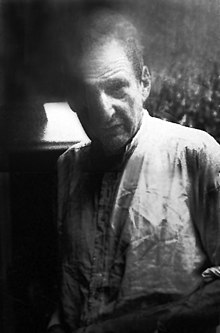
According to William Grimes of The New York Times "Lucien Freud and his contemporaries transformed figure painting in the 20th century. In paintings like Girl With a White Dog (1951-52), Freud put the pictorial linguistic communication of traditional European painting in the service of an anti-romantic, confrontational mode of portraiture that stripped bare the sitter's social facade. Ordinary people — many of them his friends — stared broad-eyed from the canvass, vulnerable to the creative person's ruthless inspection."[82] In 1952 at the 26th Venice Biennale a grouping of young British sculptors including Kenneth Armitage, Reg Butler, Lynn Chadwick, William Turnbull and Eduardo Paolozzi, exhibited works that demonstrated anti-monumental, expressionism.[83] Scottish painter Alan Davie created a large torso of abstract paintings during the 1950s that synthesize and reflect his interest in mythology and zen.[84] Abstract art became prominent during the 1950s with Ben Nicholson, Terry Frost, Peter Lanyon and Patrick Heron, who were function of the St Ives school in Cornwall.[85] In 1958, along with Kenneth Armitage and William Hayter, William Scott was called by the British Council for the British Pavilion at the XXIX Venice Biennale.
In the 1950s, the London-based Independent Group formed; from which popular art emerged in 1956 with the exhibition at the Institute of Contemporary Arts This Is Tomorrow, equally a British reaction to abstract expressionism.[86] The International Group was the topic of a ii-day, international conference at the Tate Britain in March 2007. The Contained Group is regarded equally the forerunner to the Popular Fine art movement in United kingdom and the U.s..[86] [87] The This is Tomorrow bear witness featured Scottish artist Eduardo Paolozzi, Richard Hamilton, and creative person John McHale amongst others, and the grouping included the influential fine art critic Lawrence Alloway as well.[88]
In the 1960s, Sir Anthony Caro became a leading effigy of British sculpture[89] along with a younger generation of abstruse artists including Isaac Witkin,[90] Phillip Male monarch and William G. Tucker.[91] John Hoyland,[92] Howard Hodgkin, John Walker, Ian Stephenson,[93] [94] Robyn Denny, John Plumb[95] and William Tillyer[96] were British painters who emerged at that time and who reflected the new international style of Color Field painting.[97] During the 1960s some other group of British artists offered a radical alternative to more conventional artmaking and they included Bruce McLean, Barry Flanagan, Richard Long and Gilbert and George. British pop fine art painters David Hockney, Patrick Caulfield, Derek Boshier, Peter Phillips, Peter Blake (best known for the cover-art for Sgt. Pepper's Lonely Hearts Club Band), Gerald Laing, the sculptor Allen Jones were part of the sixties art scene as was the British-based American painter R. B. Kitaj. Photorealism in the easily of Malcolm Morley (who was awarded the starting time Turner Prize in 1984) emerged in the 1960s as well every bit the op-art of Bridget Riley.[98] Michael Craig-Martin was an influential teacher of some of the Young British Artists and is known for the conceptual piece of work, An Oak Tree (1973).[99]
-

-

-

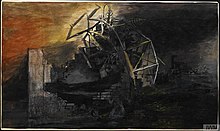
Paul Nash, The Ypres Salient at Nighttime, 1917–18, he painted some of the most powerful images of Earth War I past an English artist.[100]
-

Contemporary art [edit]

Post-mod, contemporary British fine art, particularly that of the Young British Artists, has been said to exist "characterised past a fundamental business concern with material culture ... perceived as a post-imperial cultural anxiety".[101] The annual Turner Prize, founded in 1984 and organized by the Tate, has adult every bit a highly publicized showcase for contemporary British fine art. Among the beneficiaries have been several members of the Young British Artists (YBA) movement, which includes Damien Hirst, Rachel Whiteread, and Tracey Emin, who rose to prominence later the Freeze exhibition of 1988, with the backing of Charles Saatchi and achieved international recognition with their version of conceptual art. This often featured installations, notably Hirst'due south vitrine containing a preserved shark. The Tate gallery and eventually the Regal Academy also gave them exposure. The influence of Saatchi's generous and wide-ranging patronage was to become a matter of some controversy, as was that of Jay Jopling, the most influential London gallerist.[ citation needed ]
The Sensation exhibition of works from the Saatchi Collection was controversial in both the Great britain and the U.s., though in different ways. At the Royal University printing-generated controversy centred on Myra, a very big image of the murderer Myra Hindley by Marcus Harvey, but when the show travelled to New York City, opening at the Brooklyn Museum in tardily 1999, it was met with intense protest nigh The Holy Virgin Mary past Chris Ofili, which had not provoked this reaction in London. While the press reported that the piece was smeared with elephant dung, although Ofili's work in fact showed a advisedly rendered black Madonna decorated with a resin-covered lump of elephant dung. The effigy is also surrounded by small collage images of female person genitalia from pornographic magazines; these seemed from a distance to be the traditional cherubim. Amidst other criticism, New York Mayor Rudolph Giuliani, who had seen the work in the catalogue but non in the evidence, chosen it "ill stuff" and threatened to withdraw the annual $7 million City Hall grant from the Brooklyn Museum hosting the evidence, because "You don't have a right to regime subsidy for desecrating somebody else'due south religion."[102]
In 1999, the Stuckists figurative painting group which includes Billy Childish and Charles Thomson was founded as a reaction to the YBAs.[103] In 2004, the Walker Art Gallery staged The Stuckists Punk Victorian, the starting time national museum exhibition of the Stuckist fine art movement.[104] The Federation of British Artists hosts shows of traditional figurative painting.[105] Jack Vettriano and Beryl Melt have widespread popularity, but not institution recognition.[106] [107] [108] Banksy made a reputation with street graffiti and is now a highly valued mainstream creative person.[109]
Antony Gormley produces sculptures, by and large in metallic and based on the human figure, which include the 20 metres (66 ft) high Angel of the North near Gateshead, one of the first of a number of very large public sculptures produced in the 2000s, Some other Place, and Outcome Horizon. The Indian-born sculptor Anish Kapoor has public works around the world, including Cloud Gate in Chicago and Sky Mirror in various locations; like much of his piece of work these apply curved mirror-like steel surfaces. The environmental sculptures of British globe works artist Andy Goldsworthy accept been created in many locations effectually the world. Using natural found materials they are often very ephemeral, and are recorded in photographs of which several collections in volume grade accept been published.[110] Grayson Perry works in various media, including ceramics. Whilst leading printmakers include Norman Ackroyd, Elizabeth Blackadder, Barbara Rae and Richard Spare.
Run into also [edit]
- English fine art
- Fine art of Birmingham
- Bristol School
- List of artists from Northern Republic of ireland
- Scottish art
- Listing of Scottish artists
- Welsh art
- List of Welsh artists
- Parliamentary Under Secretary of State for Arts, Heritage and Tourism
- Fine art UK
- Courtauld Found of Art
- Dulwich Picture Gallery
- Establish of Contemporary Arts
- National Gallery
- National Portrait Gallery
- Tate Britain
- Walker Art Gallery
- Whitechapel Fine art Gallery
- The Priseman Seabrook Collection
- Wallace Collection
- British Marine Art (Romantic Era)
- List of equestrian statues in the United Kingdom
- List of Turner Prize winners and nominees
- xx/21 British Art Fair
- London Art Fair
References [edit]
- ^ Strong (1999), 9–120, or come across the references at the linked articles
- ^ Waterhouse, Chapters 1-six
- ^ Waterhouse, 152
- ^ Waterhouse, 138–139; 151; 163
- ^ Waterhouse, 135–138; 147–150
- ^ Waterhouse, 131–133. The "objections" included that it was a nighttime night, the boat was small-scale, the rex not smartly dressed, and many of the nobles who accompanied him were past and then out of favour.
- ^ Waterhouse, 132–133; Pevsner, 29–30
- ^ Strong (1999), 358-361
- ^ Waterhouse, 165; 168–179
- ^ Waterhouse, 164–165
- ^ Waterhouse, 200-210
- ^ Waterhouse, 155–156
- ^ Waterhouse, 153–154, 157–160
- ^ Waterhouse, 163–164
- ^ Snowdin, 278-287, and see Alphabetize.
- ^ Snodin, 100–106
- ^ Snodin, 214-215
- ^ Stiff (1999), Chapter 24
- ^ Pevsner, 172
- ^ Snodin, 15–17; 29–31 and throughout.
- ^ Reitlinger, 58 (quote), 59-75
- ^ Waterhouse, 217-230
- ^ Waterhouse, 164–165, 225–227, and encounter Index.
- ^ Waterhouse, 227-230
- ^ Waterhouse, Affiliate eighteen; Piper, 54-56; Mellon, 82
- ^ Waterhouse, 306-311
- ^ Piper, 84; Reitlinger, 434-437 with the remarkable numbers
- ^ Waterhouse, 311-316
- ^ Reitlinger, 74-75; Waterhouse, 232-241
- ^ Pevsner, 159
- ^ Potent (1999), 478-479; Waterhouse, Chapter 20
- ^ Egerton, 332-342; Waterhouse, 285-289
- ^ Waterhouse, 315-322
- ^ Waterhouse, 327-329
- ^ Griffiths, 49, Chapter 6
- ^ snowdin, 236–242
- ^ Snodin, 154–157
- ^ Stephen Adams, The Telegraph, September 22, 2009, JMW Turner's feud with John Lawman unveiled at Tate Britain Retrieved 9 Dec 2010
- ^ Jack Malvern, The Sunday Times, September 22, 2009, Tate U.k. exhibition revives Turner and Constable's onetime rivalry Retrieved ix December 2010
- ^ "J.M.W. Turner, the Original Artist-Curator – Await Closer". Tate.
- ^ Constable's Nifty Landscapes: The 6-Human foot Paintings, National Gallery of Fine art, Washington, DC Retrieved 9 December 2010
- ^ Pevsner, 161–164; Mellon, 134; Tate 2006 Constable exhibition Tate United kingdom feature.
- ^ Piper, 116
- ^ Piper, 127–129
- ^ Lexicon of women artists Retrieved 8 Dec 2010
- ^ Shirley Paring and Jason Whittaker. Radical Blake: Influence and Afterlife from 1827. Houndmills: Palgrave, 2002.
- ^ Neil Spencer, The Guardian, October 2000, Into the Mystic, an homage to the written work of William Blake. Retrieved 8 Dec 2010
- ^ Piper, 96-98; Waterhouse, 330
- ^ Piper, 135
- ^ Piper, 84
- ^ Reitlinger, 97
- ^ Piper, 139–146; Wilson, 79–81
- ^ Piper, 149; Potent (1999), 540–541; Reitlinger, 97–99, 148–151 and elsewhere; he has detail throughout on reproduction rights.
- ^ Wilson, 85; Bills, Marker, Frith and the Influence of Hogarth, in William Powell Frith: painting the Victorian age, past Mark Bills & Vivien Knight, Yale University Press, 2006, ISBN 0-300-12190-3, ISBN 978-0-300-12190-2
- ^ Reitlinger, 157; Wilson, 85; Frith'due south Salon d'Or, Homburg (1871), now Providence, Rhode Isle, is Frith'southward last great panorama, of the gambling at Homburg [ane].
- ^ Piper, 131
- ^ Strong (1978), throughout. Encounter Appendix I for a revealing total list of pictures shown at the RA 1769–1904, analysed by subject
- ^ Potent (1978), 47-73
- ^ Conrad, Peter. The Victorian Treasure House
- ^ Fletcher, throughout
- ^ Piper, 148–151
- ^ a b Whistler versus Ruskin, Princeton edu. Archived xvi June 2010 at the Wayback Machine Retrieved xiii June 2010
- ^ a b [ii] Archived 12 January 2012 at the Wayback Machine, from the Tate, retrieved 12 April 2009
- ^ Wilson, 89-91; Rosenthal, 144, 160–162; Reitlinger, 156–157
- ^ Frayling, 12-64
- ^ Hamilton, 57-62; Wilson, 97-99
- ^ Hamilton, 146–148
- ^ Peters, Lisa N., James McNeil Whistler, pp. 51-52, ISBN 1-880908-seventy-0.
- ^ "See The Correspondence of James McNeill Whistler". Archived from the original on 20 September 2008.
- ^ Peter Stansky's review of Linda Merill'south A Pot of Pigment: Aesthetics on Trial in Whistler five. Ruskin in the Journal of Interdisciplinary History, Vol. 24, No. iii (Winter, 1994), pp. 536-537 [three]
- ^ a b McKenzie, John, Art and Empire, britishempire.co.u.k., retrieved 24 October 2008
- ^ Barringer et al 2007, p. 3.
- ^ Gothic Revival Feature from the Victoria and Albert Museum
- ^ Voysey wallpaper [ permanent dead link ] , V&A Museum
- ^ a b Jenkins et al 2005, p. five.
- ^ Wilson, 127–129; Mellon, 182–186
- ^ Camden Boondocks Group, Tate Retrieved vii Dec 2010
- ^ Scottish Colourists, Tate Retrieved 14 December 2010
- ^ "Stanley William Hayter (1901 − 1989)". Art Drove. British Quango. Archived from the original on 15 July 2010. Retrieved v October 2010.
- ^ Brenson, Michael (6 May 1988). "Stanley William Hayter, 86, Dies; Painter Taught Miró and Pollock". The New York Times . Retrieved 18 October 2008.
- ^ Walker, 219-225
- ^ "Lucian Freud, Figurative Painter Who Redefined Portraiture, Is Dead at 88". The New York Times. 21 July 2011.
- ^ "The Statuary Age Archived 5 January 2012 at the UK Government Web Archive". Tate Mag, Result half dozen, 2008. Retrieved on 9 Dec 2010.
- ^ Alan Davie, Tate Retrieved 15 Dec 2010
- ^ Walker, 211-217
- ^ a b Livingstone, M., (1990), Pop Art: A Continuing History, New York: Harry N. Abrams, Inc.
- ^ Arnason, H., History of Modern Fine art: Painting, Sculpture, Architecture, New York: Harry N. Abrams, Inc. 1968.
- ^ This is Tomorrow 1956 itemize Archived 10 July 2010 at the Wayback Car Retrieved 9 December 2010
- ^ Anthony Caro Exhibition 2005, Tate Britain Retrieved 9 December 2010
- ^ May 2006, Sunday Times obituary Retrieved ix December 2010
- ^ ISC Lifetime Achievements Honour in Sculpture Retrieved ix December 2010
- ^ tate.org.uk Archived 11 January 2012 at the Wayback Machine Retrieved 9 Dec 2010
- ^ Ian Stephenson Biography New Art Centre Retrieved ix December 2010
- ^ Ian Stephenson 1934 - 2000 Tate website Retrieved 9 December 2010
- ^ Tate Collection Retrieved 9 December 2010
- ^ William Tillyer Retrieved xv Jan 2018]
- ^ "Colorscope: Abstract Painting 1960–1979". Santa Barbara Museum of Art. 2010. Archived from the original on 3 July 2010. Retrieved ix Dec 2010.
- ^ Tate Biography Retrieved December 2010
- ^ Irish Museum of Modern Fine art Website Archived 21 May 2009 at the Wayback Machine Retrieved 9 Dec 2010
- ^ Gough, Paul (2010). A Terrible Beauty: British Artists in the First World War. pp. 127–164.
- ^ Barringer et al 2007, p. 17.
- ^ "Sensation sparks New York storm", BBC, 23 September 1999. Retrieved 17 October 2008.
- ^ Cassidy, Sarah. "Stuckists, scourge of BritArt, put on their own exhibition", The Contained, 23 August 2006. Retrieved vi July 2008.
- ^ Moss, Richard. "Stuckist's Punk Victorian gatecrashes Walker'south Biennial, Culture24, 17 September 2004. Retrieved 3 Dec 2009.
- ^ "Major new £25,000 Threadneedle art prize announced to rival Turner Prize", 24 60 minutes Museum, 5 September 2007. Retrieved seven July 2008.
- ^ Smith, David. "He's our favourite creative person. So why do the galleries hate him and then much?", The Observer, 11 January 2004. Retrieved 7 July 2008.
- ^ Campbell, Duncan. "Beryl Melt, artist who painted with a grin, dies", The Guardian, 29 May 2008. Retrieved seven July 2008.
- ^ "Painter Beryl Cook dies aged 81" BBC, 28 May 2008. Retrieved 7 July 2008.
- ^ Reynolds, Nigel. "Banksy's graffiti art sells for one-half a one thousand thousand", The Daily Telegraph, 25 October 2007. Retrieved vii July 2008.
- ^ Adams, Tim (11 March 2007). "The Interview: Andy Goldsworthy" – via www.theguardian.com.
Sources [edit]
- Barringer, T. J.; Quilley, Geoff; Fordham, Douglas (2007), Fine art and the British Empire, Manchester University Press, ISBN978-0-7190-7392-two
- Egerton, Judy, National Gallery Catalogues (new serial): The British Schoolhouse, 1998, ISBN 1-85709-170-1
- Fletcher, Pamela, Narrating Modernity: The British Problem Picture, 1895–1914, Ashgate, 2003
- Frayling, Christopher, The Regal Higher of Art, One Hundred and Fifty Years of Art and Design, 1987, Barrie & Jenkins, London, ISBN 0-7126-1820-one
- Griffiths, Antony (ed), Landmarks in Print Collecting: Connoisseurs and Donors at the British Museum since 1753, 1996, British Museum Press, ISBN 0-7141-2609-8
- Hamilton, George Heard, Painting and Sculpture in Europe, 1880-1940 (Pelican History of Art), Yale Academy Printing, revised 3rd edn. 1983 ISBN 0-14-056129-iii
- Hughes, Henry Meyric and Gijs van Tuyl (eds.), Blast to Freeze: British Art in the 20th Century, 2003, Hatje Cantz, ISBN three-7757-1248-8
- Jenkins, Adrian; Marshall, Francis; Winch, Dinah; Morris, David (2005). Creative Tension: British Art 1900-1950. Paul Holberton. ISBN978-1-903470-28-two.
- "Mellon": Warner, Malcolm and Alexander, Julia Marciari, This Other Eden, British Paintings from the Paul Mellon Collection at Yale, Yale Center for British Art/Fine art Exhibitions Australia, 1998
- Parkinson, Ronald, Victoria and Albert Museum, Catalogue of British Oil Paintings, 1820–1860, 1990, HMSO, ISBN 0-11-290463-7
- Pevsner, Nikolaus. The Englishness of English language Art, Penguin, 1964 edn.
- Piper, David, Painting in England, 1500–1880, Penguin, 1965 edn.
- Reitlinger, Gerald; The Economic science of Gustation, Vol I: The Ascension and Fall of Picture Prices 1760-1960, Barrie and Rockliffe, London, 1961
- Rosenthal, Michael, British Landscape Painting, 1982, Phaidon Press, London
- Snodin, Michael (ed). Rococo; Art and Design in Hogarth's England, 1984, Trefoil Books/Victoria and Albert Museum, ISBN 0-86294-046-X
- "Potent (1978)": Strong, Roy: And when did yous concluding see your father? The Victorian Painter and British History, 1978, Thames and Hudson, ISBN 0-500-27132-1 (Recreating the past .... in United states; Painting the Past ... in 2004 edition)
- "Stiff (1999)": Strong, Roy: The Spirit of Britain, 1999, Hutchison, London, ISBN 1-85681-534-10
- Waterhouse, Ellis, Painting in Uk, 1530–1790, 4th Edn, 1978, Penguin Books (now Yale History of Fine art series), ISBN 0-300-05319-3
- Wilson, Simon; Tate Gallery, An Illustrated Companion, 1990, Tate Gallery, ISBN 9781854370587
- Andrew Wilton & Anne Lyles, The Keen Age of British Watercolours, 1750–1880, 1993, Prestel, ISBN 3-7913-1254-5
External links [edit]
- phryne.com guide to Victorian painting (archived version)
waxmanslesintsend.blogspot.com
Source: https://en.wikipedia.org/wiki/Art_of_the_United_Kingdom
0 Response to "The Art of Critical Reading 4th Edition Answer Key Chapter 1"
Post a Comment